





10 Best AI Visibility Tools in 2026: (Compliance, Pricing, USP, G2 Rating)


Oct 05, 2026

 21 min


Your SEO dashboard may still look healthy. Rankings may be moving, traffic may be growing, and your content may be indexed. But AI search can still show your competitors, cite outdated sources, or describe your brand incorrectly.
Traditional SEO reports rarely catch this gap.
An AI visibility tool shows how your brand appears across ChatGPT, Perplexity, Google AI Overviews, Google AI Mode, Gemini, and Microsoft Copilot. It tracks mentions, citations, competitor visibility, prompt-level gaps, and technical SEO issues that may stop AI platforms from understanding your brand.
For B2B teams, this matters because buyers can now compare options and build a shortlist inside an AI answer, often before they ever visit your website.
Why You Need an AI Visibility Tool
An AI Visibility that lets you measure how your brand shows up in AI-generated answers.
Traditional SEO tools provide rankings, backlinks, technical SEO issues, and search volume. An AI visibility tools answer a different set of questions:
-
Does AI talk about your brand?
-
Are competitors mentioned more often?
-
What pages or sources are being cited?
-
Is the AI's description of your brand accurate?
-
Which prompts trigger your brand to appear?
-
Ignore your brand cues.
-
What technical or content gaps are holding you back from visibility?
AI search is now part of buyer discovery. Ahrefs Brand Radar, for example, monitors AI visibility in AI Overviews, AI Mode, ChatGPT, Copilot, Gemini, Perplexity, and Grok using search-backed prompts.
A website can rank for a keyword but still not appear when AI tools answer buyer questions. That gap is important for lead generation, because buyers might trust the AI shortlist before they visit any website.
A good AI visibility platform shouldn't just show where you appear. It should help you understand why you appear the way you do, why you are missing, and what to fix next.
Top AI Visibility Tools: Quick Comparison
|
S. No. |
Name |
Customer Rating |
Starting price |
Platform |
AI Platforms Covered |
| 1 |
Peec AI |
4.9/5 in G2 |
$95/mo |
GEO visibility analytics |
ChatGPT, Perplexity, Gemini, Google AI Overviews, AI Mode |
| 2 |
Profound |
4.6/5 in G2 |
$99/mo |
Enterprise AI visibility |
ChatGPT, Perplexity, Claude, Gemini, Grok, Copilot, Meta AI, DeepSeek, AI Overviews |
| 3 |
Otterly AI |
4.8/5 in G2 |
$29/mo |
AI search monitoring |
ChatGPT, Perplexity, Google AI Overviews, AI Mode and more |
| 4 |
Scrunch AI |
4.6/5 in G2 |
$250/mo |
AI search visibility + AXP |
Major LLMs and AI search platforms |
| 5 |
Limy |
Not verified on the official website |
Contact vendor |
AI visibility, agent intelligence, and attribution |
ChatGPT, Gemini, and Perplexity explicitly confirmed; additional engines require confirmation |
| 6 |
Yext Scout |
4.4/5 in G2 |
Enterprise only |
Local AI visibility and competitive intelligence |
ChatGPT, Gemini, Claude, Perplexity, and Google AI Overviews |
| 7 |
Nightwatch |
4.7/5 in G2 |
€112.38/mo |
SEO rank tracking and AI visibility |
ChatGPT, Claude, Gemini, Perplexity, Google AI Mode, and AI Overviews |
Quick pick
|
If you need… |
Choose |
|---|---|
|
A budget entry point |
Otterly AI (from $29/mo) |
|
An agency with many clients |
Peec AI (unlimited seats) |
|
Enterprise reporting |
Profound |
|
Crawler and agent readiness |
Scrunch AI |
|
Local or multi-location visibility |
Yext Scout |
|
AI visibility plus attribution |
Limy |
|
Rankings and AI visibility together |
Nightwatch, Ahrefs Brand Radar, or Semrush |
|
AI visibility plus traffic data |
Similarweb |
1. Peec AI
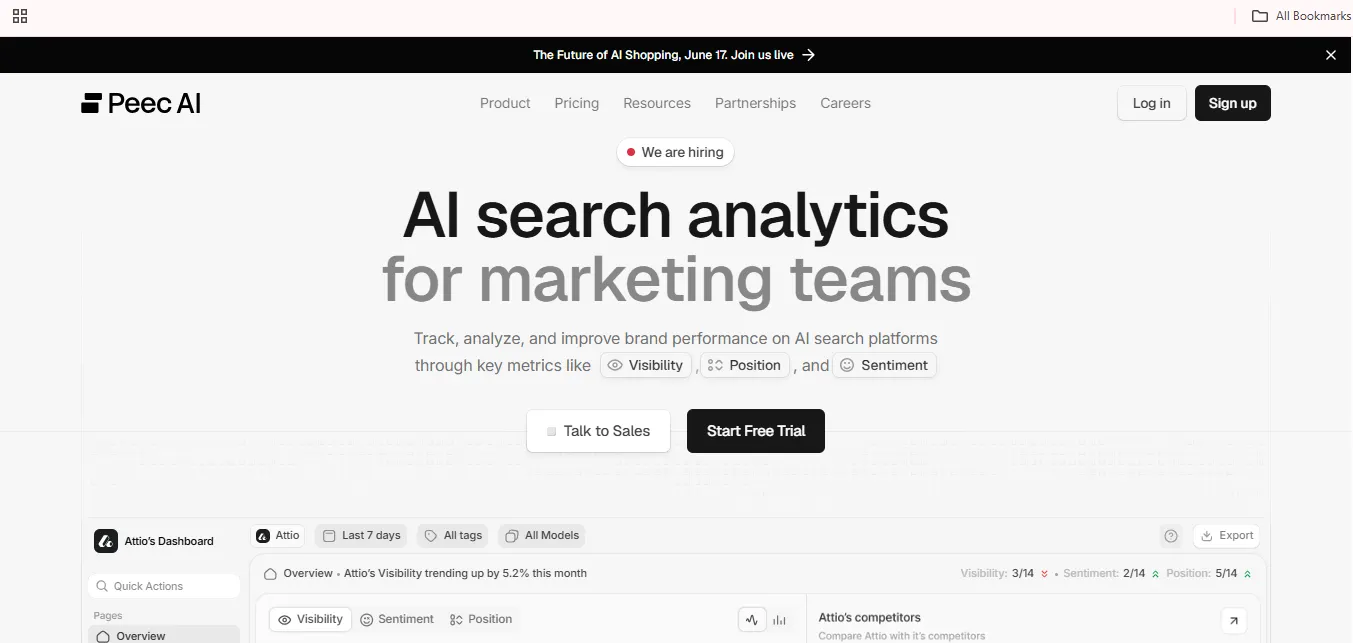
Peec AI is a focused GEO analytics tool made for teams that want clean AI visibility monitoring. It asks AI platforms questions by mimicking real browser sessions instead of directly calling APIs. This way, it gets the same answers that real users see instead of using API-based guesses.
It suggests questions based on the content of your website and keeps track of where each question stands, how people feel about it, and how many people see it. Its Actions module (which is still in beta) groups citation gaps into prioritized GEO opportunities based on how often AI models use that type of source and how big the difference is between competitors.
Best for:
-
Agencies managing multiple client brands
-
Teams wanting clean, focused AI visibility data over a feature-heavy dashboard
-
Source and citation-level analysis
-
B2B teams testing GEO before committing to a heavier platform
G2 Rating: 4.9/5
USP: Peec AI captures AI answers via simulated browser sessions instead of API calls. Unlimited team seats on all plans, which makes it perfect for agencies that manage workspaces for multiple clients without having to pay extra for each seat.
Pricing:
Starter: $95/mo
Pro: $245/mo
Advanced: $495/mo
Enterprise: Custom
Advantages:
-
Unlimited seats on every plan, simple
-
Low-clutter interface
-
The Actions module turns citation gaps into a prioritized GEO to-do list.
Disadvantages:
-
Monitoring-only, no content or technical fixes
-
Extra AI models beyond the three included are paid add-ons
-
No SOC 2 or other security certification is publicly listed.
Compliance: No SOC 2 or other formal certification publicly listed.
Deployment type: Cloud-based SaaS dashboard.
API: REST API and MCP (Model Context Protocol) integration is available on higher and agency tiers.
2. Profound
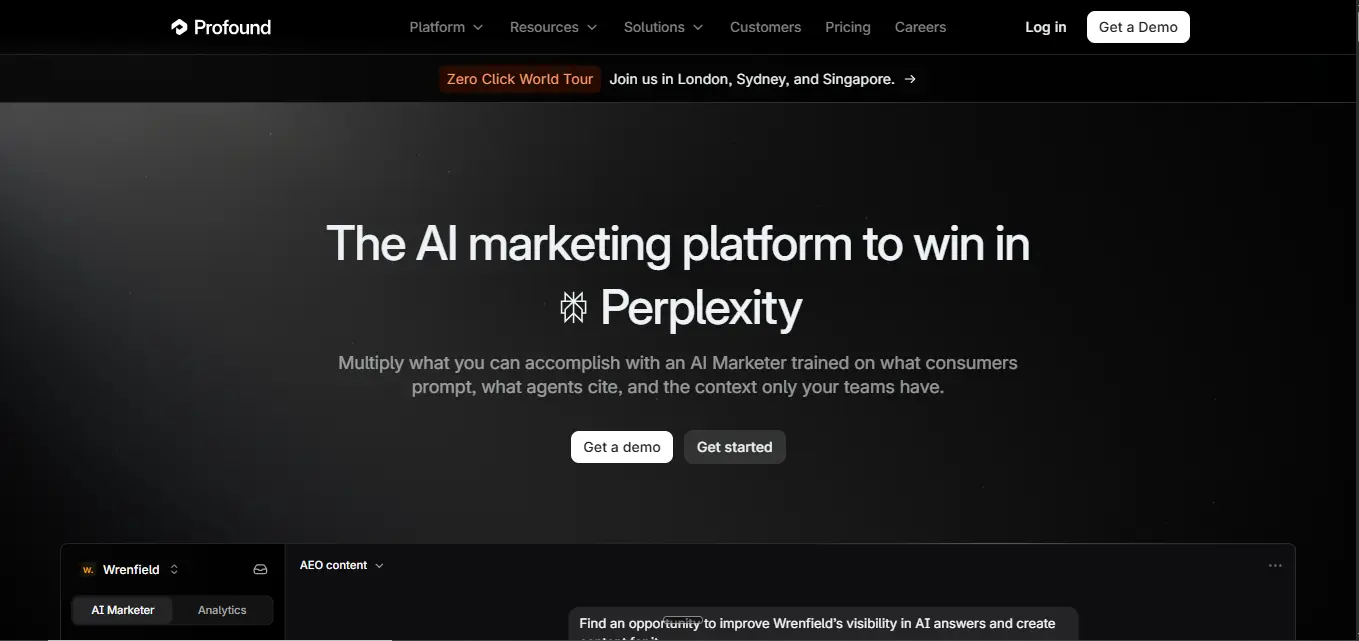
Profound is ideal for enterprise brands and agencies that require deeper AI visibility analytics. It features prompt tracking, citation analysis, competitor comparisons, source-level reporting, and AI visibility gaps.
This makes it useful for AI visibility tied to brand reputation, revenue, and executive reporting.
Profound is useful when a brand wants to know not just if they show up in AI answers, but how often, what sources are driving those answers, how competitors are being framed, and what prompts are most important.
Best for:
-
Enterprise brand
-
Massive B2B teams
-
Analytics of AI visibility
-
Competitive citation analysis
-
Teams that need in-depth reporting
Profound is a powerful choice when AI visibility is already a board-level or revenue-level priority.
G2 Rating: 4.6/5
USP: Profound is built for enterprise AI visibility, with deeper reporting around citations, competitors, prompt groups, AI visibility gaps, and source-level performance.
Pricing:
For brands:
Starter - $99/month
Growth - $399/month
For agencies Growth: $99/month + add-ons; Agency Enterprise Custom.
Advantages:
-
Clear, easy-to-read visibility analytics on where brands are mentioned
-
Consistently praised support responsiveness
-
Large G2 review base relative to category peers.
Disadvantages:
- There is a steep pricing gap between the Starter plan ($99/month), which is limited to ChatGPT with just 50 prompts, and the full multi-platform coverage, which requires the $399+/month Growth tier or higher.
- Additionally, the data can feel overwhelming and difficult to prioritize for teams that are new to GEO/AEO, and there is no free trial available on paid plans.
3. Scrunch AI
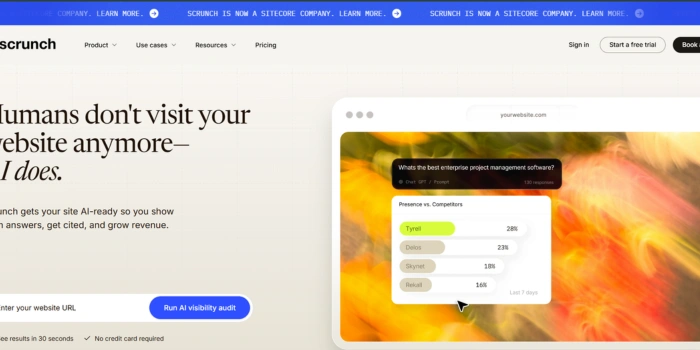
Scrunch AI is best for brands that want to combine the power of AI visibility and that care about how AI crawlers and agents understand their website. It gives you the advantage of monitoring and performing tasks like crawler access, citation insights, site audit alerts, and AI-ready content delivery
The Agent Experience Platform is particularly compelling in that it provides machine-readable versions of site content to AI agents while also maintaining the human-facing website. If AI systems cannot easily understand a site, the brand may struggle to appear in AI-generated answers even if the content is strong.
Best for:
-
Brands focusing on AI agent visibility
-
AI-ready content delivery for enterprise teams
-
Companies with technical SEO and crawlability problems
-
Teams that want monitoring plus crawler and agent optimization
Scrunch is designed for businesses that believe AI crawlers and agents will serve as a significant discovery layer.
G2 Rating: 4.6/5.
USP: Scrunch AI stands out for AI search visibility monitoring, competitor performance insights, AI citations, and site audit alerts that flag access or quality issues blocking AI crawlers.
Pricing:
For brands, $250/month
For agencies, $500/month & Custom pricing is available too
Advantages:
- A clean, user-friendly-to-use dashboard and strong customer service
- Crawler-access and site-audit alerts
Disadvantages:
-
Few actionable recommendations beyond monitoring
-
No built-in content generation or fix workflows
-
The AI Search Trends feature only covers a small, sometimes irrelevant set of topics.
-
It also costs a lot ($250–$300/month) and there is no free trial, and the flagship Agent Experience Platform (AXP) is still in beta/waitlist.
4. Otterly AI
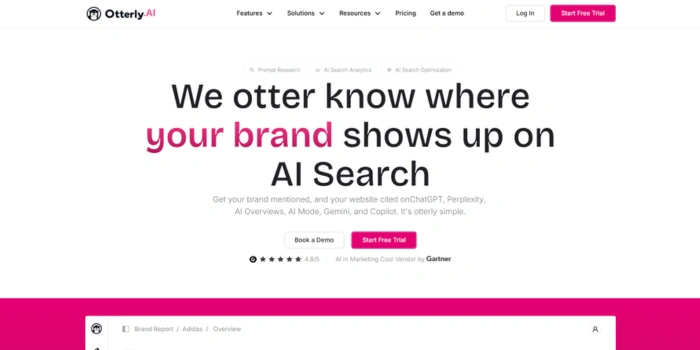
Otterly AI is a good entry point for teams that want to start tracking AI visibility without adding a heavy enterprise platform. It keeps the workflow simple: by monitoring prompts, brand mentions, citations, and competitor presence across ChatGPT, Perplexity, Google AI Overviews, and AI Mode.
It works well as a regular visibility-check tool for spotting where the brand is being mentioned, where competitors are getting picked, and which prompts need attention.
Best suited for:
- Marketing teams starting with AI visibility tracking
- Teams that produce regular AI search reports
- Ongoing monitoring
- Competitor benchmarking
Otterly is helpful when teams want a targeted way to track where they appear and where competitors are getting visibility.
G2 Rating: 4.8/5
USP: Otterly AI serves as a low-friction AI search monitoring tool that tracks brand mentions, citations, competitor visibility, and prompt-level performance across AI search platforms.
Pricing:
Lite - $29/month
Standard - $189/month
Premium - $489/month
Advantages:
-
Easy for teams new to GEO to get started
-
Unlimited brand reports and weekly automated delivery on all plans
-
White-label workspaces, useful for agencies
Disadvantages:
-
Scheduled crawl cycles can cause reporting delays, sometimes hours to days after a prompt or model change
-
The price can seem high after tracking more than a few prompts; it's not a stand-alone tool and doesn't have any backlink, keyword, or crawler data, so it needs to be used with another SEO stack.
Compliance: GDPR-compliant data handling with signed confidentiality agreements across staff and partners; PCI compliance for payments handled via Stripe; and SOC 2 compliance and SSO/SAML available on the Enterprise tier.
Deployment type: Cloud-based SaaS, plug-and-play with no code or integrations required to get started.
API: Not a core self-serve feature; available as part of custom Enterprise arrangements.
5. Limy

Limy is an AI search platform for teams that want to connect brand visibility with traffic, conversions, and revenue. It shows the prompts, answers, citations, and sources shaping how AI represents a brand, alongside competitor comparisons.
Its wider platform includes AI visitor analytics, bot traffic monitoring, and attribution. This makes it useful for businesses that want to understand both their presence in AI answers and what happens when those answers bring visitors to their website.
Best For:
-
B2B teams measuring AI-driven demo requests and signups
-
E-commerce brands tracking purchases from AI referrals
-
Marketing teams connecting visibility with business outcomes
-
Brands investigating how AI agents interact with their websites
G2 Rating: No verified rating
USP: Limy brings AI visibility, agent activity, and website attribution into one platform, helping teams connect discovery with measurable outcomes.
Pricing:
No public subscription prices are mentioned on the official website. Contact Limy for pricing.
Advantages:
-
Combines visibility reporting with AI traffic and conversion measurement.
-
Provides page-level insights into AI-driven visits.
-
Supports competitor and citation analysis.
Disadvantages:
-
Public pricing is unavailable for straightforward budget comparisons.
-
Attribution requires website tracking setup.
-
Measurement captures actions on your website; Limy explicitly states that it cannot see purchases completed inside an AI engine.
Compliance: Limy publishes privacy policies addressing GDPR, UK GDPR, CCPA, and other applicable privacy laws, including data rights and international transfer safeguards. Independent privacy certification, ISO 27001 certification,
Deployment Type: Cloud-based platform, with the Limy Pixel used for AI visitor tracking.
API: Limy supports tracking pixel and CDN integrations; confirm API availability, supported endpoints, and subscription requirements directly with the vendor.
6. Yext Scout: Best AI Visibility Platform for Local Tracking
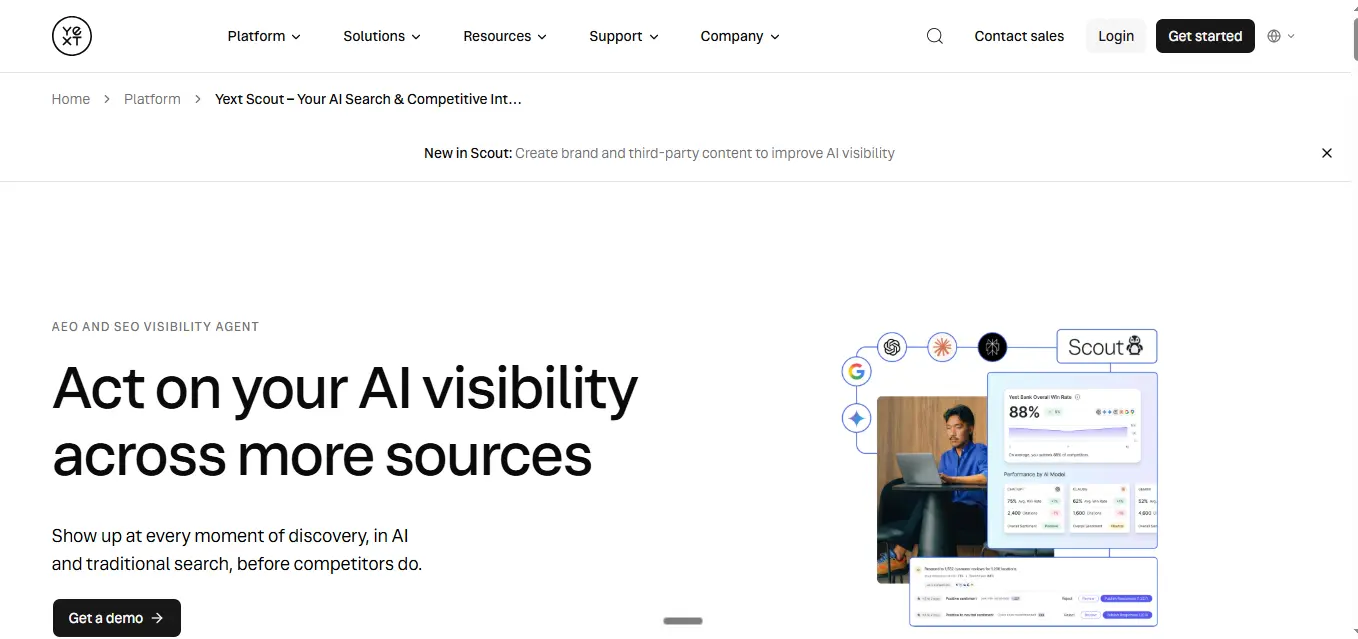
Yext Scout focuses on how individual business locations appear across AI search and traditional local search. It compares each location with nearby competitors, tracks visibility trends, analyzes brand sentiment, and identifies the sources AI platforms cite.
Its location-level reporting is particularly useful for multi-location businesses. A national visibility score can hide weak performance in individual markets; Scout helps teams see which locations need attention and which nearby competitors are appearing more often.
Best For:
-
Multi-location businesses and franchise networks
-
Local marketing teams comparing nearby competitors
-
Retail, healthcare, hospitality, and financial services brands
-
Businesses already using Yext to manage location information
G2 Rating: 4.4/5
USP: Scout combines location-level AI visibility with local competitor benchmarking and recommendations that connect to execution across the Yext platform.
Pricing:
Yext Scout pricing is enterprise-only and is not sold as a standalone line item, meaning its cost is bundled into custom enterprise.
Advantages:
-
Measures visibility at individual locations.
-
Combines AI search monitoring with Google Search and Maps.
-
Provides sentiment insights, citation tracking, and recommended actions.
Disadvantages:
-
Location-focused reporting may be less relevant for businesses without a local footprint.
-
Public subscription pricing is unavailable.
-
Execution uses agents across the Yext platform, so buyers should confirm which products their package includes.
Compliance: Yext’s Trust Center provides security documentation; confirm the requirements applicable to your Scout subscription.
Deployment Type: Cloud-based Yext platform, with mobile access.
API: Scout API and MCP access are officially announced for Yext’s partner ecosystem. Confirm access eligibility with Yext.
7. Nightwatch
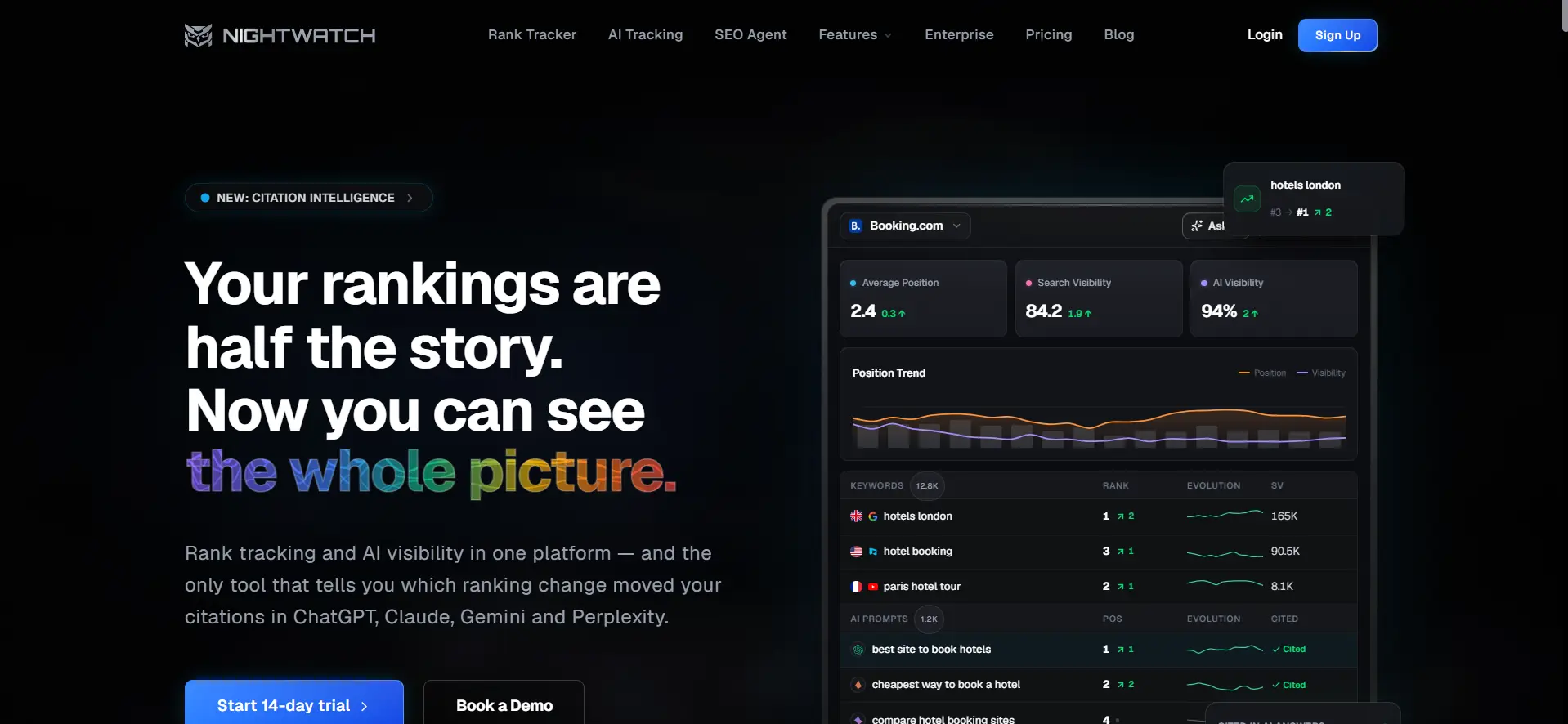
Nightwatch combines traditional SEO rank tracking with AI visibility monitoring. Teams can track whether AI models mention their brand, how prominently it appears, the sentiment surrounding it, and which sources support the answer.
Its citation and competitor dashboards sit alongside existing SEO workflows. This makes it useful for agencies and in-house teams that want to investigate organic rankings and AI discovery within the same platform.
Best For:
-
SEO teams combining rankings and AI visibility reporting
-
Agencies managing several websites
-
Brands comparing mentions and citations across AI models
-
Teams needing prompt research and source analysis
G2 Rating: 4.7/5, as displayed on Nightwatch’s official website.
USP: Nightwatch brings SEO rankings, AI mentions, citations, and competitor intelligence into one reporting workflow.
-
Annual billing, as shown on the official pricing page: Starter €112.38/mo; Professional €225.90/mo; Agency €566.45/mo; Enterprise custom
Advantages:
-
Combines traditional search and AI visibility tracking.
-
Provides prompt, sentiment, competitor, and citation analysis.
-
Offers a trial before committing to a subscription.
Disadvantages:
-
AI prompt and response allowances vary by plan.
-
The starter includes 50 AI prompts, which may limit broader tracking.
-
The pricing page places API access and Looker Studio integration under Professional and higher plans.
Compliance: Nightwatch states GDPR and SOC 2 compliance, offers a Data Processing Agreement on request, and lists encryption at rest and in transit. Enterprise includes SSO and advanced security controls. A public SOC 2 audit report and its Type I or II status could not be verified; ISO 27001 status is not public.
Deployment Type: Cloud-based SaaS.
API: Nightwatch offers a REST API for custom reporting, ranking data, and keyword management on Professional and higher plans. You should confirm AI visibility API access with the vendor.
All-in-One SEO Platforms with AI Visibility Tracking
The below-mentioned AI tools provide you with a variety of options that you can use to improve your AI visibility. These tools are the most widely used and are, in a sense, the evergreen tools in this field.
1. Ahrefs Brand Radar
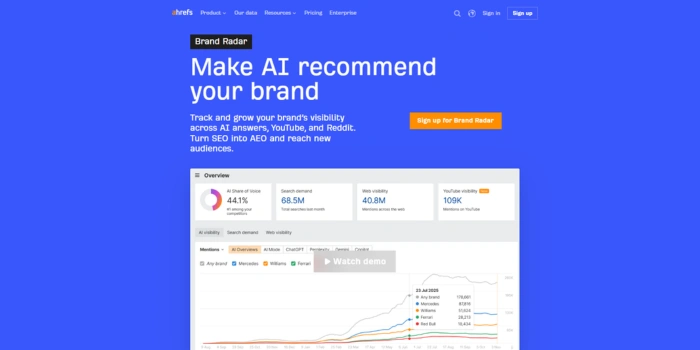
Ahrefs Brand Radar’s biggest strength is not just its ability to track mentions across AI platforms. The real value is that it connects AI visibility with Ahrefs’ existing search, backlink, keyword, and competitor intelligence.
That makes it useful when a team wants to understand whether AI visibility is being influenced by organic rankings, brand authority, content depth, or competitor search presence.
It also tracks AI visibility using search-backed prompts across AI Overviews, AI Mode, ChatGPT, Copilot, Gemini, Perplexity, and Grok. It also highlights a large monthly prompt dataset, which makes it useful for market-level visibility tracking.
Best for:
-
SEO teams already using Ahrefs
-
Competitor research in AI search
-
Benchmarking brand visibility
-
AI SEO impact tracking for content and technical SEO teams
B2B businesses can use Ahrefs Brand Radar to tie AI visibility to traditional SEO data. That matters when you’re doing a technical SEO audit, planning a website migration, or checking if competitors are showing up more often in AI answers.
G2 Rating: 4.5/5
USP: It connects AI visibility tracking with Ahrefs’ broader SEO database, making it useful for teams that want AI SEO, competitor visibility, backlinks, keyword data, and technical SEO insights in one workflow.
Pricing:
It’s a $199/month add-on
Advantages:
-
It connects changes in AI visibility to existing organic ranking and content-gap data; that search-backed prompt data feels rooted in real question volume.
-
The unified dashboard can see mentions from AI engines as well as YouTube, TikTok, and Reddit.
Disadvantages:
-
Reviewers say it's hard to tell the difference between a mention and a real citation
-
It costs a lot to add extra indexes (about $199/month on top of the base plan); tracking for YouTube, TikTok, and Reddit is still not reliable in beta.
Compliance: No AI-visibility-specific certification publicly highlighted; standard Ahrefs enterprise data-handling terms apply.
Deployment type: Cloud-based SaaS, integrated into the core Ahrefs platform.
API: Available, though reviewers note it's best suited to teams with in-house data science or BI capacity to use it fully.
2. Semrush AI SEO Suite
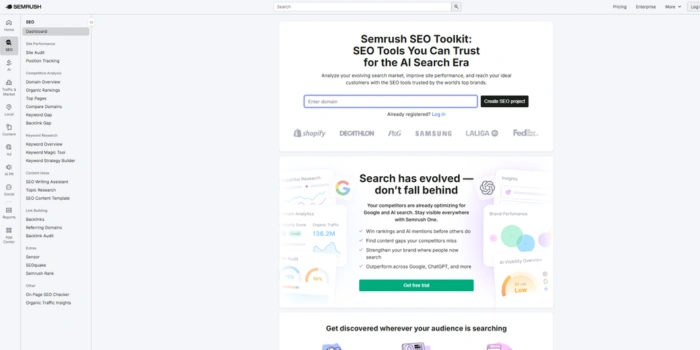
Semrush works better for agencies that need AI visibility inside a wider marketing stack. The value is not only AI mentions but also the ability to compare them with SEO audits, PPC research, content gaps, traffic movement, and competitor performance.
It fits teams that already report from Semrush and want AI visibility added to that same client dashboard.
Best for:
-
Teams that are already using Semrush
-
Classic SEO metrics for AI SEO reporting
-
Technical SEO & SEO audit processes
-
Agencies running multiple client campaigns
This feature is particularly helpful for B2B brands that need to connect AI visibility to lead generation metrics, organic traffic, and campaign performance.
G2 Rating: 4.5/5
USP: It combines AI visibility tracking with Semrush’s existing SEO, PPC, content, competitor, and technical SEO tools, making it useful for teams that want AI SEO inside a broader marketing suite.
Pricing: $99 per month.
Trial: No, the AI Visibility Toolkit does not offer a free trial.
Advantages:
-
AI visibility is built into current data on competitors, backlinks, and keywords; data visualization is strong.
-
Reporting limits are high, and G2 satisfaction for help and depth is always excellent.
Disadvantages:
-
It's challenging for newbies to learn how to use it, it costs a lot, and the AI layer is built on top of an old SEO suite instead of a new AEO tool.
Compliance: Enterprise data-handling documentation (SOC 2/GDPR) is available through Semrush's trust center on request.
Deployment type: Cloud-based SaaS.
API: Available on business-tier plans and higher.
3. Similarweb AI Search Intelligence
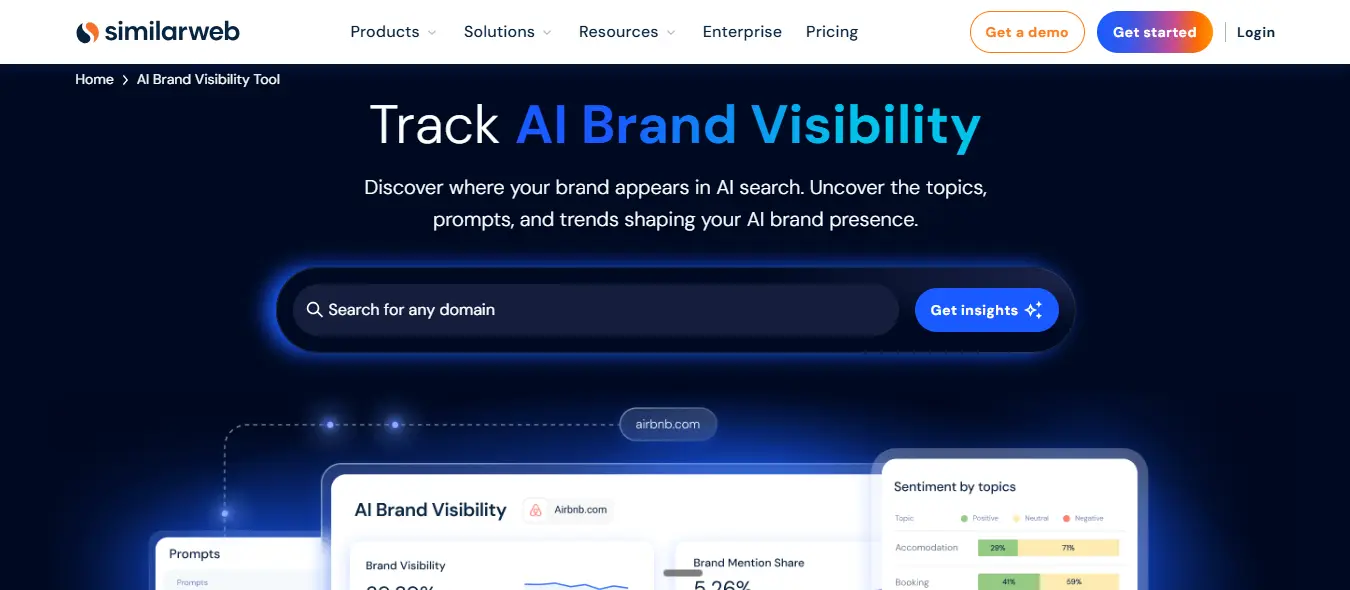
Similarweb is useful for teams that want to connect AI visibility with competitor traffic and broader SEO performance. Its AI Brand Visibility tool tracks brand mentions, citations, sentiment, and competitor presence, while its AI Traffic tool shows how AI platforms drive visits to websites.
This helps teams understand where competitors are gaining visibility, which sources influence AI answers, and how AI referrals fit into the wider marketing channel mix.
Brand visibility tracking covers ChatGPT, Gemini, Perplexity, and Google AI Mode. Its broader AI traffic reporting also includes platforms such as Claude, Grok, and Microsoft Copilot.
Best For:
-
SEO teams combining AI visibility with competitive research
-
B2B brands comparing AI mentions and referral traffic
-
Agencies reporting on search and website performance
-
Marketing teams identifying citation and content opportunities
G2 Rating: 4.4/5
USP: Similarweb combines AI brand visibility and referral traffic analysis with broader SEO and competitive intelligence, helping teams evaluate AI discovery alongside other marketing channels.
-
AEO Intelligence: $99/month billed annually
-
AEO & SEO & Competitive Intel: $333/month billed annually
-
AEO & SEO & Ads & Competitive Intel: $542/month billed annually
-
Business packages: Custom pricing
Trial: A free trial is offered on the official pricing page.
Advantages:
-
Combines AI mentions, citations, sentiment, and referral traffic reporting.
-
Benchmarks competitors across topics and prompts.
-
Offers packages that include keyword research, rank tracking, site audits, backlinks, and website traffic intelligence.
Disadvantages:
-
The entry plan does not include the broader SEO toolkit.
-
Listed self-service packages include one user and 150 tracked prompts.
-
Historical data is limited to three months on the entry plan and six months on the higher listed packages.
-
Brand visibility tracking covers fewer AI platforms than its AI traffic reporting.
Compliance: Similarweb’s official security page lists SOC 2 Type II and ISO 27001 validation, with additional documentation available through its Trust Center.
Deployment Type: Cloud-based SaaS within Similarweb’s digital intelligence platform.
API: Available through custom business packages or as a standalone product. Confirm access to specific AI visibility metrics before purchasing.
How to Pick the Best AI Visibility Tool
The best AI visibility tool depends on your business model, workflow, and maturity.
1. Begin With Your AI Platforms
Pick the tool that matches where your buyers are searching. B2B brands’ priority platforms generally are:
-
ChatGPT
-
Gemini Google AI Summaries
-
Microsoft Copilot Claude (Anthropic)
If you’re selling to enterprise buyers, check if the tool also supports regional tracking, prompt segmentation, competitor analysis, and citation reporting.
2. Pick the Right Tool for Your Workflow
For monitoring, some tools are best. Better for implementation
Pick according to your team need:
-
Monitoring only: Otterly AI, ZipTie AI
-
SEO suite + AI visibility: Ahrefs, Semrush, SE Ranking
-
Content optimization: Surfer Enterprise AI visibility: Profound, AthenaHQ, Scrunch GEO action planning: Goodie AI
3. Check Technical SEO assistance
AI visibility depends on crawlable, structured, and trusted content. Your tool should help identify or connect you with issues like the following:
-
Crawling spaces
-
Indexing issues
-
Broken links within the site
-
Issues with structured data
-
Duplicate content
-
Weak page speed
-
Risks of website migration
-
Poor source pages
If a tool only tracks mentions but does not help you understand what to fix, you may still need a separate technical SEO process.
4. Check for Competitor Tracking
AI visibility is relative.
It’s not enough to know whether your brand is showing up. You need to know whether competitors appear more often, which prompts they win, and which sources AI engines cite for them.
This helps with:
-
ABM messaging
-
Content planning
-
Digital PR
-
Lead generation strategy
-
SEO audit prioritization
5. Prioritize Actionable Reporting
A good AI visibility tool should show the following:
-
Where you appear
-
Where you are missing
-
Which sources are cited
-
What competitors own
-
Which pages need improvement
-
What content or technical SEO fixes should come next
The goal is not to report for reporting’s sake. The goal is better AI SEO execution.
Conclusion
Buyer discovery is changing, and AI visibility tools are becoming a must-have.
Now, a B2B buyer can request vendor comparisons, and if your brand isn’t showing up in those answers shown by Copilot, Gemini, Perplexity, or Google AI Overviews, you’re at risk of losing awareness, trust, and lead generation opportunities before the buyer even gets to your funnel.
The right AI visibility tool allows you to track mentions, citations, competitors, sentiment, source pages, and prompt level gaps. It also gives your team a clearer roadmap for improving AI SEO, technical SEO, content structure, SEO audit priorities, ABM messaging, and website migration planning.
This feature can help you understand when buyers ask AI tools about your category: Does your brand show up? Does the answer help you build trust?



Your SEO, on autopilot
Saffron OS runs 15+ AI agents that audit your visibility across Google, ChatGPT, Gemini and Perplexity every day — then fix what's broken, automatically. Built over 18 months. Results in 2–15 minutes.
Explore Saffron OSFrequently Asked Questions
Can AI visibility tools help with competitor research?

Yes. Strong tools show which competitors appear for the same prompts, which sources support them, and what gaps your brand is missing. That helps you spot content opportunities, PR targets, and pages that need stronger proof or structure.
What is the difference between AI visibility and traditional SEO?
Traditional SEO measures rankings, clicks, backlinks, and impressions. AI visibility measures whether your brand is mentioned, cited, recommended, or summarized inside generated answers. A page can win SEO traffic and still lose AI discovery if the answer engines do not trust or extract it well.
How do I improve AI visibility without rebuilding my whole site?
Start with high-impact fixes: tighten your homepage and product pages, add schema, create direct-answer FAQs, refresh comparison pages, and expand credible third-party mentions. Then track a small prompt set over time so you can see which changes actually move citations and mentions.
Does Reddit actually help AI visibility?
Yes, Reddit is frequently cited across AI search tools, especially for Q&A and comparison-style discussions. A recent Semrush analysis found that Reddit remains a leading source, and AI systems often paraphrase Reddit content rather than quoting it directly. That makes authentic participation in niche threads more valuable than shallow promotion
What prompts should I test to measure AI visibility?
Use real buyer questions like “best [category] for [use case],” “alternatives to [competitor],” “which [tool] is best for [industry],” and “who recommends [service] near me”. The goal is to test commercial intent prompts, not just brand-name prompts, because that is where shortlist decisions usually happen.
Which is the best software for AI mode tracking?
Profound is the strongest overall if you want enterprise-grade AI visibility tracking across many platforms, but Peec AI is the better practical pick for most teams because it is focused, clean, and easier to adopt. Except this, Otterly AI is also great if you want a lighter monitoring-first tool at a lower entry point.
What is the best tool for identifying visibility gaps in AI search results and increasing visibility?
Profound is best when you want deep analysis, citation tracking, and recommendations to improve visibility, while AthenaHQ and Scrunch AI are also strong for AEO and GEO workflows. Except this, Cognizo is a strong option if you want one tool that tracks and helps improve AI Overviews visibility in the same workflow.
Are there affordable visibility tools with due diligence workflows?
Yes, ZipTie AI is the cheapest entry-style option, Otterly AI is affordable and monitoring-led, and Peec AI gives a good value balance between price and usefulness. Except this, SE Ranking and Semrush’s free AI visibility checker are good due-diligence starting points if you want to validate visibility before paying for enterprise tools.
How can I track shifts in competitor presence across AI platforms?
Track a fixed set of prompts weekly across ChatGPT, Gemini, Perplexity, Claude, Copilot, and AI Overviews, then compare mentions, citations, and share of voice over time. Except this, use tools like Profound, Peec AI, or Otterly AI to spot when competitors start appearing more often, losing citations, or winning new prompts.

Shreya Debnath

Shreya Debnath is a Marketing Manager at Saffron Edge with over 5 years of experience in SEO, AI-driven marketing, growth marketing, and technical SEO. She has hands-on expertise in optimizing existing content, improving performance, and driving scalable growth through data-backed strategies. She has worked with international markets, especially the US and UK, and diverse teams to build effective marketing campaigns, strengthen brand positioning, and enhance audience engagement across multiple channels. Her approach focuses on aligning sales and marketing to ensure consistent and measurable results. Outside of work, Shreya enjoys exploring new cities, pursuing creative hobbies, and discovering unique stories through travel and local experiences.
Related Blogs
We explore and publish the latest & most underrated content before it becomes a trend.



Subscribe to Saffron Edge Newsletter!


Your SEO, on autopilot
Saffron OS runs 15+ AI agents that audit your visibility across Google, ChatGPT, Gemini and Perplexity every day — then fix what's broken, automatically. Built over 18 months. Results in 2–15 minutes.
Explore Saffron OS